


Version archive via REST API
The version archive documents changes to baubook product and characteristic values. From version 3 onwards, versioning is also available via the REST API.
Know exactly what has changed — down to the field, down to the day, and in a reproducible manner
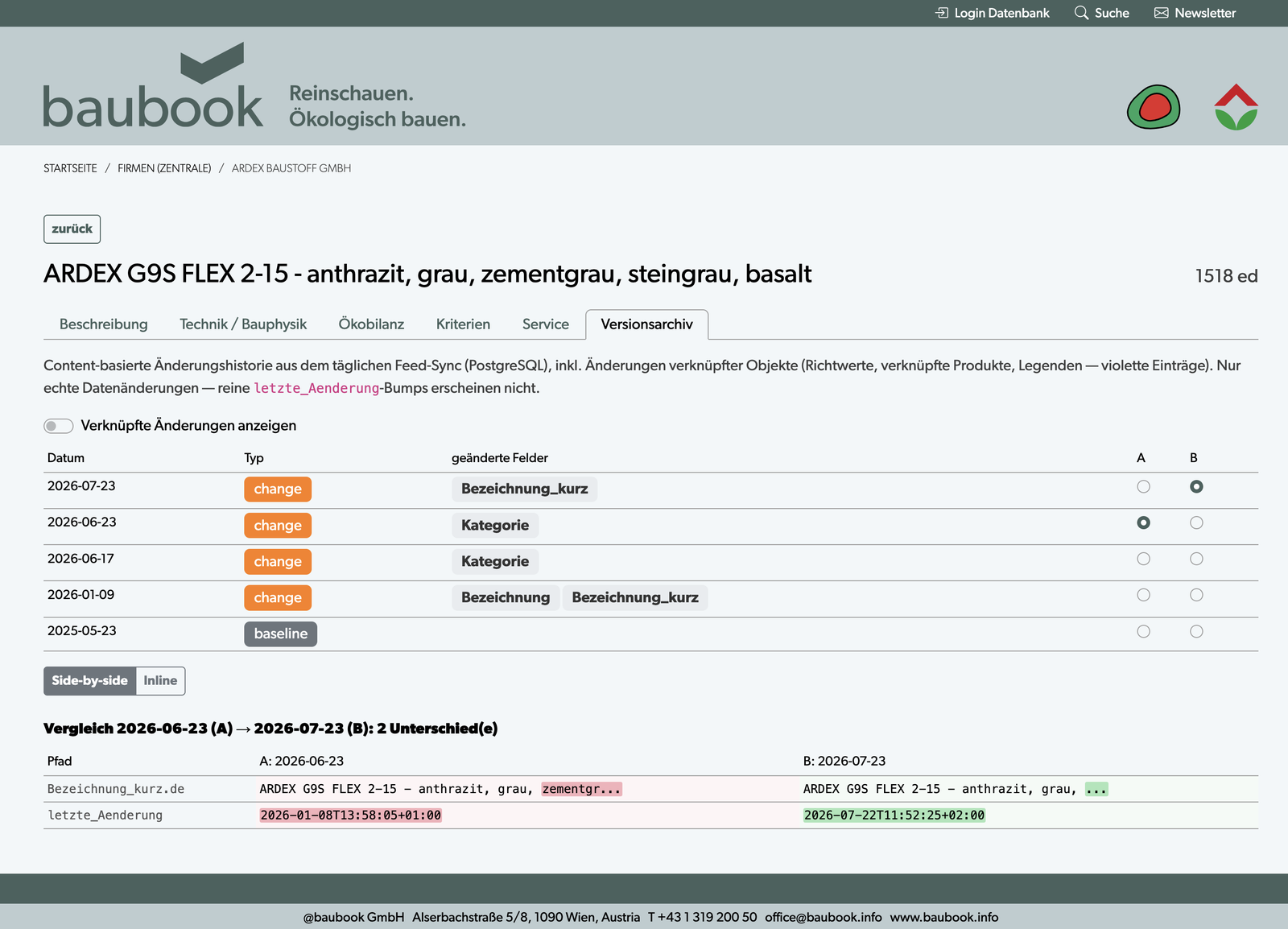
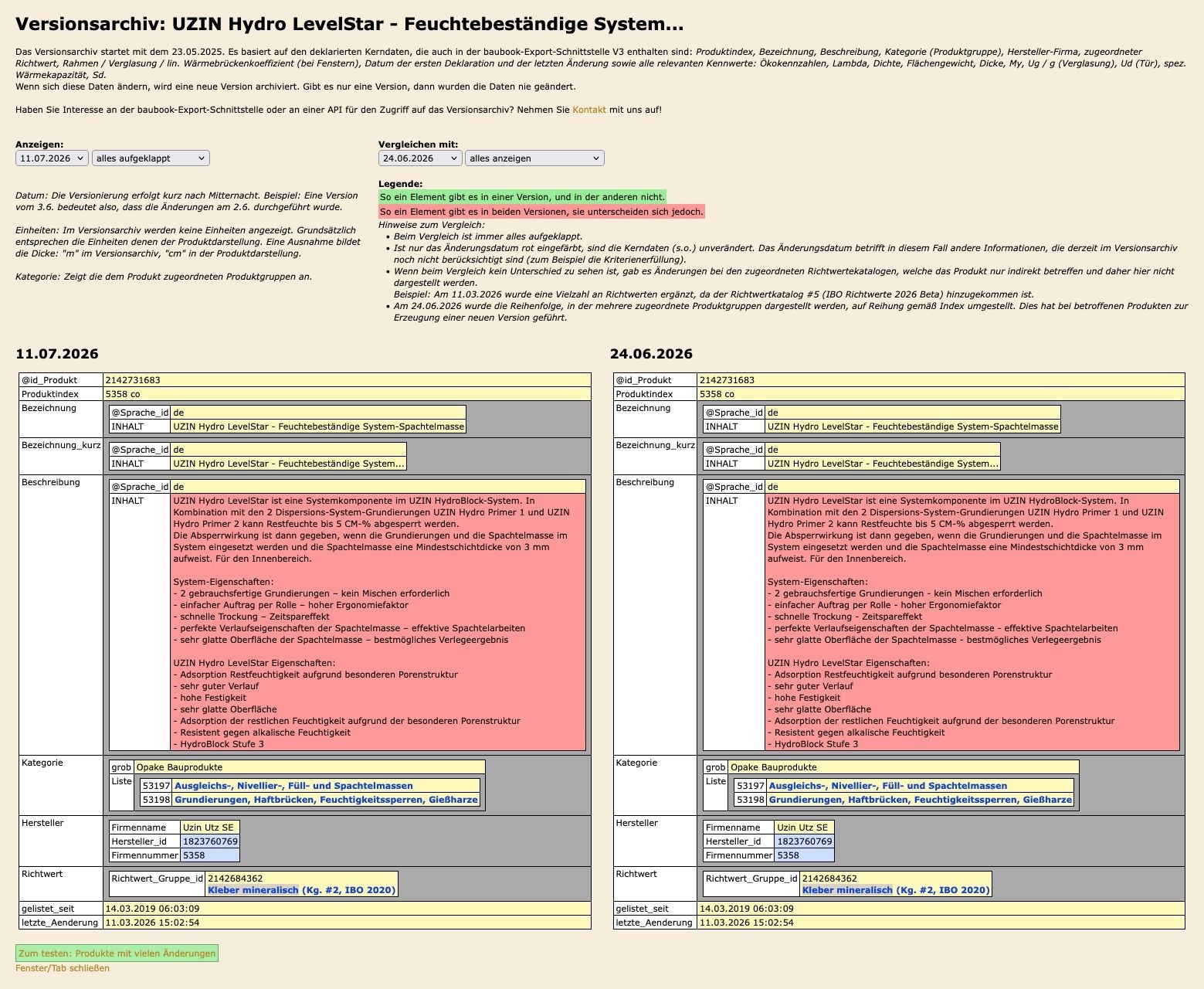
From version 3 onwards, the baubook REST API offers a content-based change history (version archive) for the reference values and product data it contains. Data users can see, down to the day, which fields have changed. For software developers and their programmes, this means that, when updating data, only the actual change delta needs to be loaded and synchronised, rather than the entire dataset as was previously the case (‘Delta Sync’).
Software developers benefit from Delta-Sync
Delta-Sync provides software developers with a convenient solution. A single parameter is all that is required: ‘modified since’ returns only those products whose content has changed since the last synchronisation. This saves bandwidth, processing time and waiting time. Each product includes metadata (modified, last_change) that shows at a glance what has happened most recently.
Documented data links to reference values
The reference values linked to the products are incorporated into the product display. If a reference value affecting a product changes, this appears in the change history — as a separate, clearly labelled entry. All changes are straightforward to see and document. Reproducible reference dates Versioning also allows previous data sets to be retrieved by reference date (retroactively up to May 2025). Whether it’s an energy performance certificate or a life cycle assessment — with the ‘as-of’ date retrieval, the API provides the exact product data status for any given date (‘as-of’). A calculation from March can be substantiated in December using the March data. The Diff endpoint also shows, field by field, what has changed between two reference dates — including old and new values.
Simple Integration
The REST, JSON interface provides a complete OpenAPI schema — generated clients (NSwag, Kiota & Co.) work straight out of the box. The interactive documentation, the Swagger UI and a machine-readable entry point for AI assistants (llms.txt) simplify integration.
Are you a software developer and interested? We’d love to hear from you!
Please use our application form.