


The new 2026 EcoBuilding Criteria Catalogue is here
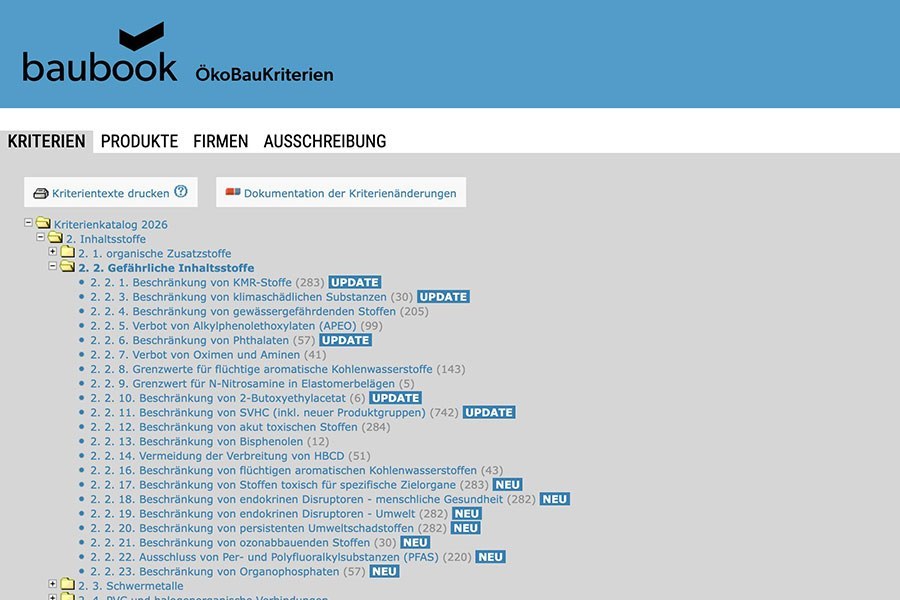
Following a five-year period of validity, the EcoBuilding Criteria were comprehensively updated and published in September 2026 on www.baubook.at/oea as the 2026 Criteria Catalogue.
What are EcoBuilding Criteria?
Access to the EcoBuilding Criteria database »
The aim of the EcoBuilding Criteria is to ensure that the selection of building materials is guided more strongly by environmental considerations. The criteria are harmonised throughout Austria and beyond: They can be found in the ‘EcoProcure Vienna Criteria Catalogues’ for building construction and interior fit-out, as well as in the ‘Vorarlberg Municipal Building Certificate’ (KGA), the ‘LNB – Guide to Sustainable Building’ published by the Ravensburg district, and in the federal criteria catalogues (‘naBe’ and ‘klimaaktiv’). The criteria are also harmonised with all relevant guidelines of the Austrian Ecolabel in the construction sector.
The EcoBuilding Criteria set out minimum requirements and define the supporting evidence required to meet them. They relate to precisely defined product groups in each case. In addition, there are explanatory notes and, where necessary, links to supplementary background information. The minimum requirements are worded in such a way that they are straightforward to incorporate into specifications. The criteria catalogues are drawn up by experts from various specialist fields – such as chemistry, ecotoxicology, building physics, civil engineering and architecture – and are subsequently reviewed for their legal validity. According to a decree issued by the Director of the Vienna City Council, the EcoProcure Vienna criteria catalogues are to be applied on a mandatory basis to all building projects undertaken by the City of Vienna.
What is new?
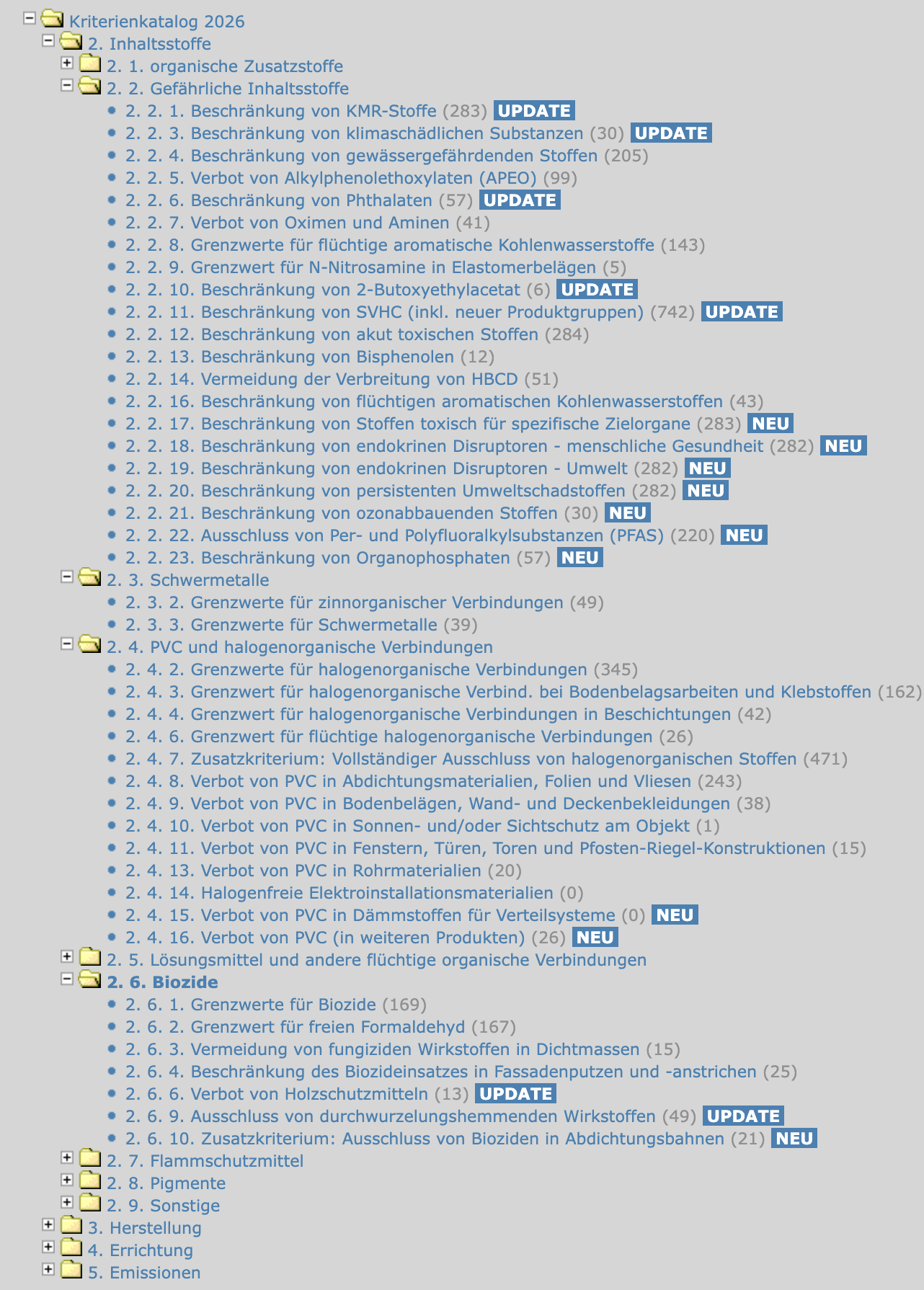
The changes to the EcoBuilding Criteria Catalogue 2026 include both entirely new criteria and revised requirements, such as adjusted threshold values or technical clarifications. To help you find your way around quickly, new criteria in baubook are marked with the label ‘NEW’ and amended criteria with the label ‘UPDATE’. You can download the documentation detailing the changes in the 2026 Criteria Catalogue compared with the 2020 catalogue here. Some key revisions are outlined below.
The 2026 list of criteria introduced restrictions on further substances with hazardous properties. The number of the relevant criterion is given in square brackets; the product groups concerned can be found in the baubook in the description of the respective criterion:
- Endocrine disruptors are chemical substances that interfere with the endocrine system by mimicking, blocking or altering the action of natural hormones. In April 2023, the EU introduced labelling requirements for such substances; from 1 May 2028, this requirement will apply to all substances and mixtures [2.2.18 und 2.2.19].
- Substances classified as specifically target organ toxic (STOT Categories 1 and 2) have long been excluded from eco-labels. These substances have now also been included in the list of restricted substances under the EcoBuilding Criteria [2.2.17].
- Persistent organic pollutants as defined by the POP or CLP Regulations are now also explicitly excluded[2.2.20].
- The placing on the market of ozone-depleting substances with H420 is already prohibited throughout the EU. However, as proof is still required under the DNSH criteria of the EU Taxonomy, the criterion has also been included in the EcoBuilding Criteria for formal reasons [2.2.21].
- PFAS are considered particularly concerning as they are highly persistent in the environment – i.e. they do not degrade in practice – and are therefore also referred to as ‘forever chemicals’. PFAS can accumulate in soil, water, animals and the human body. Studies show links to cancer, endocrine disruption, immune deficiency and reproductive problems [2.2.22].
- Organophosphate esters (OPEs) were introduced as substitutes for polybrominated diphenyl ethers (PBDEs), which are banned under the Stockholm Convention. A comparative analysis and a ‘regrettable substitution dilemma’ by Qadeer et al. (2024) show that the physical and chemical properties, environmental behaviour and global concentrations of PBDEs and OPEs are similar and, in many cases, overlap [2.2.23].
Some criteria have been adapted to new legislative frameworks. For example, Regulation (EU) 2024/573 on fluorinated greenhouse gases has replaced the Austrian HFCs, PFCs and SF₆ Regulation, Federal Law Gazette II 447/2002 [2.2.3 ‘Restriction of climate-damaging substances’]. Some of the substances hazardous to health previously restricted in [2.2.10] are in any case classified as CMR [2.2.1] or are phthalates [2.2.6]. The criterion has therefore been reduced to the restriction on 2-butoxyethyl acetate.
The limit values for volatile organic compounds (VOCs) have largely been simplified [2.5.X]. For example, there are no longer any additional requirements for SVOCs with sensitising properties, as the permissible SVOC content is already very low. The requirements for sustainable timber management [3.3.X] have been updated, as have the limit values for VOC and SVOC emissions [5.1.X]. Furthermore, a limit value for formaldehyde emissions – as required by the EU Taxonomy Regulation – has been added to the limit values for SVOC and VOC emissions from resilient and textile floor coverings, as well as from insulation materials.
There are now also EcoBuilding Criteria for green roof products. These were drawn up with the support of the Interreg Alpine Rhine–Upper Rhine project ‘zukunftsgrün’. In line with the City of Vienna’s funding conditions for green roofs, the ban on biocides and root-inhibiting substances now applies to all waterproofing membranes [2.6.9 and 2.6.10].
What happens next?
In the next step, users will integrate the criteria into their procurement and evaluation systems and announce when the new criteria will come into effect. In any case, the 2020 criteria catalogue will remain published on baubook for some time to come for ongoing projects.
Source
Qadeer, A.; Mubeen, S.; Liu, M.; Bekele, T. G.; Ohoro, C. R.; Adeniji, A. O.; Alraih, A. M.; Ajmal, Z.; Alshammari, A. S.; Al-Hadeethi, Y.; Archundia, D.; Yuan, S.; Jiang, X.; Wang, S.; Li, X.; Sauvé, S. (2024): Global environmental and toxicological impacts of polybrominated diphenyl ethers versus organophosphate esters: A comparative analysis and regrettable substitution dilemma. Journal of Hazardous Materials, Volume 466, 2024, 133543, ISSN 0304-3894. DOI: 10.1016/j.jhazmat.2024.133543.